top of page
SECDEF HEGSETH, SEC-DNI GABBARD, FBI DIRECTOR PATEL, AND JOINT CHEIFS SEAL

OPEN LETTER TO:

SECRETARY OF DEFENSE PETE HEGSETH,

USINDOPACOM,

JOINT REGION MARIANAS,

NAVFAC MARIANAS,

AND THE COMMITTEE ON LEGISLATION TO COMBAT THE CCP’S MALIGN INFLUENCE


RE: The Strategic Imperative for DoD Oversight, Eminent Domain Enforcement, and Federal Investigations into Rampant Corruption in the CNMI


I. Introduction

The strategic importance of the Commonwealth of the Northern Mariana Islands (CNMI) within the U.S. Indo-Pacific defense framework cannot be overstated. As geopolitical tensions heighten and the threat of malign influence from foreign adversaries—particularly the Chinese Communist Party (CCP)—continues to grow, it is imperative that the United States government act decisively to ensure national security interests are protected across all territories, including the CNMI.


This letter is a call to action for the Secretary of Defense, Mr. Pete Hegseth, the U.S. Indo-Pacific Command (INDOPACOM), Joint Region Marianas, NAVFAC Marianas, and the Committee on Legislation to Combat the CCP’s Malign Influence to recognize and exercise full federal authority to combat corruption, prevent national security compromise, and reaffirm American sovereignty in the region.

Furthermore, it is time for the Trump #AmericaFirst agenda and the incoming Congress to re-evaluate the CNMI’s continued exclusion from the full constitutional protections afforded by the 5th, and 14th Amendments. The CNMI's existing legal framework fosters unchecked corruption, enables systemic fraud, and weakens the rule of law by shielding bad actors from accountability. In addition, the CNMI's Block Grant designation must be stripped to allow for the full application of federal oversight mechanisms, performance-based funding, and enforcement of U.S. regulations regarding transparency and accountability.

II. Strategic National Security Interests and Eminent Domain

Under the constitutional power of eminent domain and its national defense prerogatives, the U.S. Department of Defense (DoD) holds the authority to acquire and protect land deemed essential to U.S. strategic objectives. The Mariana Islands’ geographic proximity to Taiwan, the South China Sea, and Pacific routes vital to U.S. military and economic operations elevates their importance.

The DoD’s legal right to exercise eminent domain in U.S. territories, including the CNMI, stems from the Fifth Amendment of the Constitution and has been reaffirmed in multiple federal precedents. This authority is also complemented by national defense statutes, such as the Military Construction Authorization Acts, which authorize land use for defense installations and critical infrastructure.

As federal investigations and public reports have shown, CNMI landowners, politicians, and foreign-affiliated developers have obstructed vital land access for military purposes in pursuit of personal enrichment. In recent years, congressional reports and watchdog media—such as Stars and Stripes, ProPublica, and local CNMI investigative outlets—have exposed real estate fraud, misappropriated federal funds, and an increasing trend of land speculation tied to foreign entities operating under the guise of tourism and casino development.

This raises a critical national security question: how long will federal agencies tolerate obstruction and foreign encroachment on U.S. strategic defense land before invoking the full power of eminent domain?

III. The SHIELD Act and Congressional Mandates

The proposed SHIELD Act (H.R. 708) specifically targets malign foreign influence in the United States, with provisions that empower federal agencies to monitor and counter CCP-linked operations that compromise American institutions, including infrastructure in territories such as the CNMI.

The CNMI has emerged as a loophole in this mandate. Foreign adversaries have capitalized on weak local governance, a judiciary compromised by family ties and corruption, and the territory’s unique "commonwealth" status, which allows for inconsistent application of federal oversight.

The SHIELD Act’s mission must be extended in full force to U.S. territories.

This includes immediate investigations into foreign-backed developments in Saipan, Tinian, and Rota; mandatory vetting of land deals; and the automatic freezing of federal funds linked to compromised entities or individuals.

The Committee on Legislation to Combat the CCP’s Malign Influence must ask: why has the CNMI not yet been declared a hotbed of foreign interference? Where are the federal prosecutions? Why has the U.S. judiciary failed to hold the CNMI’s elite accountable for their role in aiding adversarial influence and misusing federal grants?

IV. Reaffirming Sovereignty and Constitutional Protections

It is time for the federal government to reassert its jurisdiction and values across all American territory. The CNMI cannot continue to exist in a constitutional gray zone where the Fifth, Eighth, and Fourteenth Amendments are ignored, and federal statutes are treated as optional guidelines.

This legal limbo directly contradicts the very mission of national security. The Trump Administration and its allies in Congress must reintroduce legislation to fully incorporate the CNMI into the U.S. Constitution’s protective reach and eliminate legal doctrines—such as the Insular Cases—that enable second-class governance.

The absence of federal prosecution against CNMI officials who have repeatedly stolen public money, obstructed DoD land efforts, and sold influence to foreign entities is indefensible. The U.S. must act, not only for security but also for justice.

V. The Block Grant Problem

The CNMI’s continued receipt of massive federal funding through unrestricted block grants—without performance-based auditing or strict compliance guidelines—has fostered decades of financial abuse. This funding model enables local elites to siphon federal dollars with impunity.

Multiple reports by the Government Accountability Office (GAO), Department of the Interior’s Office of Inspector General, and independent audits have shown tens of millions of dollars either unaccounted for, mismanaged, or fraudulently spent in the CNMI. Public housing, Medicaid, education grants, disaster recovery funds, and even DoD subcontracting programs have all been named in reports from 2006 through 2023.

The solution is simple: revoke the CNMI’s Block Grant status and replace it with program-specific funding tied to clear benchmarks, audits, and federal oversight.

Local agencies must be required to comply with the same regulations as any U.S. state or federal contractor.

VI. Conclusion: A Call to Federal Action and Constitutional Enforcement

For the defense of the nation and the rule of law, we urge Secretary of Defense Pete Hegseth, INDOPACOM, NAVFAC Marianas, and the Congressional Committee on Combating CCP Influence to initiate:

1. A full review of all land holdings in the CNMI that obstruct national security objectives.

2. The use of eminent domain where local resistance, corruption, or foreign affiliation interferes with DoD operations.

3. A reexamination of the CNMI’s political and legal structure to bring it fully under the Constitution—particularly the 5th, and 14th Amendments.

4. An end to the CNMI’s Block Grant status and an overhaul of its federal funding model.

5. Immediate DOJ and FBI-led investigations into the CNMI judiciary, elected officials, and foreign development deals.

The time has come for an #AmericaFirst agenda to extend beyond the mainland and encompass every inch of American soil—including the Pacific Islands where silence has enabled betrayal.

We stand ready to provide supporting documents, whistleblower testimony, and audit records upon request.

For justice, security, and the future of American sovereignty.

Foreign Real Estate Control and CCP Proxies in the CNMI

Documented investigations and public records have demonstrated a troubling pattern: shell companies and CCP-linked developers have targeted CNMI lands for speculative casino developments, shadow infrastructure, and data control hubs. These actors exploit lax territorial oversight, court corruption, and economic desperation to bypass federal vetting protocols.


Through public-private partnerships, bribery, and influence over local legislators, these developers have successfully sidelined U.S. military land access requests, delayed federal facility upgrades, and in some cases, co-opted strategic waterfront properties adjacent to DoD land.

This is not simply mismanagement — it is textbook subversion.


Justification for Immediate DoD Action

Given the convergence of:

• unchecked corruption in CNMI’s executive and judicial branches;

• real estate and political manipulation by CCP-linked actors;

• stalled federal investigations due to territorial non-cooperation;

• and the immediate geostrategic importance of the region—

the Department of Defense must move beyond diplomatic pressure and toward lawful seizure of critical land and infrastructure via eminent domain.


We recommend:

1. Deployment of a Joint DoD-Congressional Investigative Task Force to catalog all foreign-held lands and assets within 50 miles of defense facilities in the CNMI.

2. Immediate pause and federal review of all CNMI land leases and casino developments involving foreign nationals.

3. Assertion of eminent domain where CCP-tied holdings directly threaten base expansion, digital security, or strategic readiness.

4. Direct coordination with the U.S. Indo-Pacific Command and Homeland Security to declare CNMI a special national security interest zone under wartime readiness protocols.


***Please, Review Some of our Other Articles:


Conclusion

This letter is a call to action, not a cry for symbolic oversight. The CNMI is at risk of becoming the weakest link in the Indo-Pacific security chain — not due to geography, but due to negligence, corruption, and infiltration. We urge the DoD, Congress, and strategic regional commands to exercise their full constitutional, statutory, and moral authority to protect this critical territory from collapse — before it is too late.

Respectfully Submitted,

Zaji Zajradhara aka: PERSONA NON GRATA

Authors’ Profile


Zaji "Persona Non Grata" Zajradhara: A Voice for the Voiceless


Zaji "Persona Non Grata" Zajradhara isn't just an author; he's a force of nature. A staunch advocate for American workers and Indigenous rights in the CNMI, Zaji's life reads like a gritty urban novel, filled with struggle, resilience, and an unwavering commitment to justice. Labeled "persona non grata" by the CNMI government for his relentless pursuit of truth and his outspoken criticism of corruption, Zaji has become a symbol of resistance against those who seek to exploit the islands and its people. As an unemployed Afro-American father, he knows firsthand the sting of the CNMI's dysfunctional labor market, its rigged political system, and the exploitation of vulnerable communities. His experiences fuel his activism, driving him to file numerous legal claims against companies for violating labor laws and discriminating against American workers. Zaji's voice, though silenced by the establishment, resonates through his writing, exposing the harsh realities faced by those on the margins. But Zaji's compassion extends far beyond the shores of the CNMI. As Program Director of CNMIGA.org, a non-profit dedicated to providing humanitarian assistance in Myanmar, he leads a team committed to delivering essential support and resources to communities in need. Zaji's story is a testament to the power of one person to make a difference. He is a writer, an activist, a humanitarian – a true urban warrior fighting for a more just and equitable world.
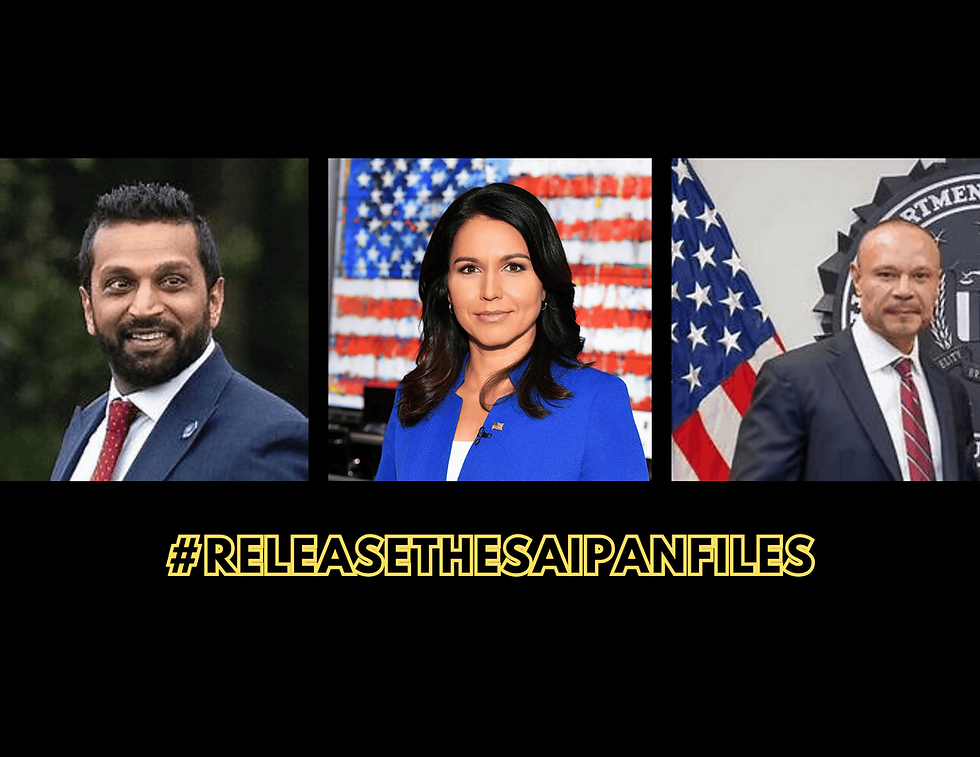


FBI DIRECTOR KA$H PATEL, DNI DIRECTOR TULSI GABBERD & DEPUTY FBI DAN BONGINO

Dear Director Patel, Deputy Director Bongino, and Director Gabbard, *** EDITORS NOTE: THIS IS A REWRITE FROM CNMIGA.ORG PRESPECTIVE

The Commonwealth of the Northern Mariana Islands (CNMI), a U.S. territory in the Pacific, stands at a critical juncture. Systemic corruption, foreign influence, and the suspicious death of a reformist governor demand your immediate attention. The Imperial Pacific International casino investigation, once a beacon of hope for accountability, lies dormant, buried under layers of political interference and local complicity. We urge you to reopen and reevaluate this investigation, ensuring that all personnel involved are sourced from off-island agencies, rigorously screened to eliminate any ties to CNMI or Guam entities, families, or associations. The call for #ReleaseTheSaipanFiles is not just a plea for transparency—it’s a demand to safeguard U.S. national security and restore trust in a territory teetering on the edge of foreign control. Below, we outline the case for action, supported by evidence, historical context, and a vision for justice.


ree

The CNMI: America’s Vulnerable Outpost

"The CNMI is a microcosm of how strategic neglect can turn a U.S. territory into a playground for foreign influence and corruption." – Cleo Paskal

Nestled in the Western Pacific, the CNMI—comprising Saipan, Tinian, and Rota—is a strategic linchpin, located just hours from Beijing, Tokyo, and Seoul. Its role in World War II, as the staging ground for the atomic bombings, cemented its geopolitical importance. Yet, today, this U.S. territory is better known for its systemic corruption, described by a federal judge as one of the most corrupt jurisdictions per capita in the nation. The CNMI’s unique immigration policies, allowing visa-free entry for Chinese and Russian nationals, have created a backdoor into U.S. soil, exploited by the Chinese Communist Party (CCP) through economic and political channels. The Imperial Pacific International casino in Saipan, which processed $5.3 billion in its first three months of 2017, stands as a glaring symbol of this exploitation, with allegations of money laundering and human trafficking.


Former Governor Arnold Palacios, who died under suspicious circumstances in July 2025, had called for federal intervention, offering evidence to the FBI and Treasury Department. His death, coupled with the influence of local operatives like Angel Demapan and groups like the United Filipino Organization (UFO), underscores the need for an independent investigation. The dormant Imperial Pacific investigation, known as the "Saipan Files," must be reopened to expose these networks. To ensure impartiality, all investigators must come from off-island agencies, free from CNMI or Guam connections, as local ties—whether familial, political, or through organizations like the UFO—could compromise the process. #ReleaseTheSaipanFiles is the rallying cry to demand accountability and protect this vital U.S. territory.


A History of Exploitation and Neglect

"The CNMI’s history is a story of strategic importance clashing with administrative neglect, creating a vacuum for foreign powers to exploit." – Cleo Paskal

The CNMI’s journey from Japanese control (1914–1944) to U.S. commonwealth status in 1975 is a tale of strategic promise undermined by neglect. As a U.S. territory, it grants citizenship to its residents but retains unique immigration and labor laws, which have been exploited by foreign actors, particularly the CCP. In the 1990s, Chinese firms used these loopholes to establish garment factories, producing "Made in the USA" goods with cheap labor. After China’s WTO accession in 2001, these factories gave way to tourism and casino ventures, with the Imperial Pacific casino becoming a hub for illicit activity. The visa-free entry policy for Chinese nationals has facilitated unchecked access, enabling financial flows that bypass U.S. oversight. Local operatives like Angel Demapan, tied to former Governor Ralph Torres, have facilitated deals benefiting Chinese investors, while federal funds meant for development have been misallocated to projects linked to these schemes. The United Filipino Organization, under the guise of humanitarian aid, is suspected of labor trafficking, channeling Filipino workers into CCP-aligned projects.

The "Saipan Files," seized by the FBI during the initial Imperial Pacific investigation, reportedly contain evidence of these activities, yet the probe stalled, possibly due to local influence. Reopening this investigation with off-island personnel, screened for any CNMI or Guam ties, is critical to uncovering the truth. The #ReleaseTheSaipanFiles campaign demands that these files see the light of day, exposing the historical exploitation that continues to undermine U.S. sovereignty in the CNMI.


The Imperial Pacific Casino: A Money Laundering Hub

"The CNMI’s economy is a textbook case of how foreign money can exploit weak governance to turn a U.S. territory into a hub for illicit activity." – Cleo Paskal

The Imperial Pacific International casino in Saipan is not just a gambling venue—it’s a potential epicenter for money laundering and CCP influence. Processing $5.3 billion in transactions in just three months in 2017, it dwarfed Macau’s top casinos, raising red flags about its true purpose. Allegations of human trafficking and financial crimes have swirled around the operation, which was supported by former Governor Ralph Torres and advised by former CIA Director James Woolsey and former FBI Director Louis Freeh. The casino’s success relied on the CNMI’s visa-free entry policy, allowing Chinese nationals to move funds and personnel with minimal scrutiny.

FORMER GOV RALPH TORRES W/ HIS RIGHT-HAND MAN: ANGEL DEMAPAN

Angel Demapan, a political fixer, allegedly brokered deals that enriched local elites while advancing CCP interests. The United Filipino Organization, purportedly aiding Filipino workers, is suspected of facilitating labor schemes tied to the casino, further entangling foreign and local interests. Federal funds, intended for economic development, have been diverted to projects benefiting these networks, with little oversight. The original FBI investigation into Imperial Pacific uncovered critical evidence—the "Saipan Files"—but was halted, possibly due to local pressures. Reopening this investigation with off-island agents, free from CNMI or Guam connections, is essential to tracing these illicit flows and dismantling the networks. The urgency of #ReleaseTheSaipanFiles lies in exposing these financial crimes and preventing the CNMI from becoming a permanent hub for CCP-driven malfeasance.

Political Corruption and Local Complicity

"Corruption in the CNMI isn’t just local—it’s a network that connects local elites with foreign actors, all profiting at the expense of U.S. security." – Cleo Paskal

The CNMI’s political landscape is riddled with corruption, with local officials entangled in schemes that benefit foreign actors.

Former Governor Ralph Torres, a key supporter of the Imperial Pacific casino, was linked to land deals that enriched his family, facilitated by operatives like Angel Demapan, whose influence spans local and federal circles. Current CNMI congressional representative Kimberly King-Hines has pushed for increased Chinese access, advocating for visa-free entry and more direct flights from China, despite national security concerns. Her husband, the CNMI’s chief prosecutor, and her brother, now a key legislator, create a web of potential conflicts.

The United Filipino Organization, while claiming to support Filipino workers, is suspected of labor trafficking and money laundering, aligning with CCP goals. Federal funds, totaling millions annually, have been allocated to CNMI projects with minimal accountability, some allegedly funneled into ventures benefiting foreign entities. The "Saipan Files" reportedly contain evidence of these connections, yet the investigation stalled, possibly due to interference from local power structures. Reopening the probe with off-island investigators, screened for any ties to CNMI or Guam families, agencies, or associations, is critical to rooting out this corruption. The #ReleaseTheSaipanFiles movement demands transparency to expose these networks and hold complicit officials accountable, ensuring U.S. interests are protected.

FORMER GOV RALPH TORRES & ANGEL DEMAPAN FAVORITE CASINO

The Suspicious Death of Governor Arnold Palacios

"The sudden death of a reformist governor in a corrupt territory raises red flags that can’t be ignored." – Cleo Paskal

Governor Arnold Palacios’ sudden death in July 2025 is a chilling reminder of the stakes in the CNMI. A reformist who challenged the status quo, Palacios wrote to the FBI and Treasury Department in April 2025, offering evidence of public corruption and requesting federal intervention. His death, during a U.S. military exercise in Saipan, was marred by delays in medical evacuation, raising suspicions of foul play.

The rapid clearing of his office and the fear among local anti-corruption advocates suggest a cover-up.

Palacios had clashed with figures like Angel Demapan and criticized the United Filipino Organization for its role in exploitative labor practices tied to CCP-linked projects. Federal funds, which he sought to redirect toward transparent development, were often misallocated to ventures benefiting foreign interests.

FORMER GOVERNOR Arnold Palacios @ FDD with Ms Cleo Paskal

The "Saipan Files" may hold clues to the networks Palacios sought to expose, making their release critical. An independent investigation into his death, conducted by off-island personnel with no ties to CNMI or Guam, is essential to determine the truth and address local fears.

The #ReleaseTheSaipanFiles campaign is a call for justice, ensuring that Palacios’ efforts to clean up the CNMI are not in vain and that those responsible face accountability.

THEY DEFRAUDED AND STOLE HUNDREDS OF MILLIONS IN FEDERAL FUNDS; YET...ZERO PROSECUTIONS

Aligning with Executive Order 14249

"The financial opacity in places like the CNMI is exactly why we need stronger federal oversight to protect U.S. interests." – Cleo Paskal

Executive Order 14249, signed on March 25, 2025, aims to protect U.S. financial systems from fraud, waste, and abuse, offering a framework to address the CNMI’s financial vulnerabilities.

The Imperial Pacific casino’s untracked billions, coupled with the United Filipino Organization’s labor schemes and Angel Demapan’s political dealings, highlight the need for rigorous oversight of federal funds. EO 14249’s emphasis on pre-certification verification and transparency aligns with the need to track funds diverted to CCP-linked projects. The CNMI’s visa-free entry policy and casino operations provide a conduit for illicit financial flows, potentially linked to money laundering and drug trafficking. Reopening the Imperial Pacific investigation with off-island agents, screened for any CNMI or Guam connections, will ensure compliance with EO 14249 and uncover misuse of federal funds. The #ReleaseTheSaipanFiles campaign amplifies this call, demanding transparency to safeguard the CNMI’s economy and prevent it from becoming a hub for CCP-driven interference.

CNMI CONNECTED FRIENDS AND FAMILIES DEFRAUDED HUNDREDS OF MILLIONS- NO PROSECUTIONS

A Call to Action


"If we don’t act decisively, the CNMI will remain a weak link in America’s Pacific defenses." – Cleo Paskal

Directors Patel, Bongino, and Gabbard, the CNMI’s corruption threatens U.S. national security.

We urge you to:

1. Reopen the Imperial Pacific Investigation: Deploy an off-island FBI strike force, screened for any CNMI or Guam ties, to reevaluate the "Saipan Files."

2. Audit Federal Funds: Conduct a comprehensive audit of all federal funds disbursed to the CNMI, focusing on misuse tied to the UFO and operatives like Demapan.

3. Investigate Palacios’ Death: Launch a federal inquiry into Governor Palacios’ death, using off-island personnel to ensure impartiality.

4. Close Visa Loopholes: Work with DHS to eliminate visa-free entry for Chinese nationals, curbing CCP influence.

5. Expose CCP/UFO Networks: Investigate the UFO and local operatives for ties to CCP-driven schemes.

6. Support #ReleaseTheSaipanFiles: Release the "Saipan Files" to the public to ensure transparency and accountability.

The CNMI is a U.S. territory, not a foreign playground. #ReleaseTheSaipanFiles is the clarion call to restore justice and protect America’s Pacific frontier. Act now.

Sincerely,

The American Public

CHECK OUT THESE OTHER ARTICLES ON CNMI CORRUPTION:

(5) ORIGINAL CHINA UNCENSORED INTERVIEW W/ CLEO PASKAL:


Bibliography

• China Unscripted Podcast Transcript, 2025.

• Executive Order 14249, "Protecting America's Bank Account Against Fraud, Waste, and Abuse," March 25, 2025.

• GAO-22-105271, "Commonwealth of the Northern Mariana Islands: Recent Workforce Trends and Wage Distribution," February 2022.

• GAO-25-107560, "U.S. Territories: Public Debt and Economic Outlook - 2025 Update," June 2025.

• Campbell, Matthew. "The Dark Pool: A Pacific Island, a Chinese Casino, and a $3.8 Billion Mystery," Bloomberg, 2018.

Appendix

• CNMI Workforce Data (GAO-22-105271): U.S. workers increased from 50% to 59% from 2016 to 2020.

• Public Debt Figures (GAO-25-107560): CNMI’s public debt was $121 million as of September 30, 2021.

• Key Figures:

o Governor Arnold Palacios: Deceased July 2025, reformist.

o Ralph Torres: Former governor, tied to casino interests.

o Kimberly King-Hines: Advocates for Chinese access.

o Angel Demapan: Political operative, linked to corruption.

o United Filipino Organization: Suspected of labor trafficking.


ree

Urgent Demand for Forensic Investigations into Commonwealth Healthcare Corporation (CHCC)


To: The Trump Administration and Secretary Robert F. Kennedy Jr.

Date: July 15, 2025

Subject: Immediate Forensic Investigations and Accountability at CHCC


Introduction


We at CNMIGA.ORG, representing concerned citizens and advocates for transparency, accountability, and the protection of American patients, demand immediate forensic investigations into the Commonwealth Healthcare Corporation (CHCC) in Saipan, Northern Mariana Islands (NMI). For decades, CHCC has engaged in practices that harm American patients, defraud taxpayers, and exploit federal resources, as evidenced by audits, reports, and open-source data. This comment outlines the systemic failures necessitating federal intervention and cites applicable laws and regulations to enforce accountability.


Grounds for Investigation


1. Patient Harm by Unqualified Foreign Workers


CHCC’s reliance on foreign medical workers from non-American accredited institutions has caused documented patient harm. The Report on the Necessity of Federal Receivership for CHCC (June 9, 2025) notes that these workers, often lacking English proficiency, contribute to medical errors, misdiagnoses, and surgical mistakes. Patient testimonials corroborate these findings, highlighting violations of 42 U.S.C. § 1395, which mandates adequate safeguards for patient care under Medicare standards. The JANUARY 11, 2024 MINUTES reveal approvals of foreign locum staff (e.g., Dr. Sabine Kelischeek, Dr. Mohammad Hasssein) without evidence of U.S. accreditation, exacerbating risks to indigenous American patients.


Demand: Cease employment of unqualified foreign workers and mandate that all medical staff graduate from American-accredited schools in good standing, per 42 CFR § 482.22, requiring competent staffing.


2. Fraud, Waste, and Abuse of Federal Funds

Audits reveal CHCC’s systemic financial mismanagement. The Treasury OIG Report (2023) identified $11.1 million in questioned costs from federal block grants, while the CHCC FY 2019 Compliance Report (Findings 2019-004 to 2019-016) documents material weaknesses in internal controls, including unsupported expenditures. The CNMI Visa Crisis Report notes $20 million in FEMA funds diverted post-Typhoon Yutu, violating 31 U.S.C. § 7501 (Single Audit Act). These practices defraud American taxpayers, contravening 18 U.S.C. § 371, which prohibits conspiracy to defraud the United States.


Demand: Conduct a forensic audit of all federal funds since 2008, as authorized under 31 U.S.C. § 7502, to recover misallocated resources and impose penalties.


3. Executive Staff Enrichment Amid Patient Suffering

While CHCC owes $85 million to the Commonwealth Utilities Corporation (CUC) per House Bill 24-49, executive staff have received pay raises, prioritizing personal wealth over patient care. The CHCC FY 2024 Citizen-Centric Report highlights investments in equipment, yet patient outcomes remain poor, indicating misprioritization. This breaches the fiduciary duty under 42 CFR § 482.12, requiring hospital governance to ensure quality care.


Demand: Freeze executive salaries until CHCC achieves financial stability and meets patient care standards, enforceable under 42 U.S.C. § 1395dd.

YET, NONE OF THEM WILL TAKE A SALARY REDUCTION OR REMOVE THE NON-AMERICANS FROM THE PROGRAM???

4. Refusal to Carry Malpractice and Liability Insurance


CHCC’s lack of malpractice and liability insurance deviates from U.S. healthcare norms, endangering patients and staff. The Report on the Necessity of Federal Receivership underscores this gap, violating the implied duty of care under 42 U.S.C. § 1395 and exposing CHCC to legal risks under tort law (Restatement (Second) of Torts § 323).


Demand: Mandate full medical malpractice and liability insurance, tied to federal funding eligibility under 42 CFR § 482.11.

5. Burden on American Taxpayers


CHCC’s refusal to address its $85 million debt, coupled with reliance on federal bailouts (e.g., $50 million in grants since 2008 per CNMI Visa Crisis Report), burdens American taxpayers. The Public Law No. 23-09 document reveals the CNMI government’s failure to remit $8.6 million in FY 2023 Medicaid funds, further straining CHCC. This violates 31 U.S.C. § 6301, ensuring fair use of federal assistance.


Demand: Enforce a repayment plan for the $85 million debt, per 31 U.S.C. § 6305, and halt federal funding until compliance is achieved.


6. Failure to Develop Sister-State Programs


CHCC’s refusal to partner with American hospitals and schools, opting instead for non-English-speaking foreign workers, undermines care quality. The Report on the Necessity of Federal Receivership highlights this neglect, contravening HRSA guidelines for improving healthcare access through collaboration.


Demand: Establish sister-state programs with U.S. institutions, mandated under 42 U.S.C. § 254b, to ensure qualified American staff.

Evidence of Decades-Long Fraud


The CHCC FY 2019 Compliance Report reveals a pattern of noncompliance with federal regulations, with findings (e.g., 2019-001 to 2019-016) spanning general ledger issues, inventory mismanagement, and procurement violations. These issues, repeated from prior audits, indicate a decades-long scheme to defraud taxpayers, necessitating forensic scrutiny under 31 U.S.C. § 7503.


Legal Basis for Action


42 U.S.C. § 1395: Ensures patient care safeguards, violated by CHCC’s staffing and insurance practices.


18 U.S.C. § 371: Criminalizes fraud against the U.S., applicable to federal fund misuse.


31 U.S.C. § 7501: Requires audits and accountability for federal awards, breached by CHCC’s weak controls.


42 CFR § 482: Sets hospital participation conditions, unmet by CHCC’s staffing and governance failures.


Case Law: Darling v. Charleston Community Memorial Hospital (1965) establishes hospital liability for staff competency, supporting our demands.


and you cannot sue broke chcc..this has to stop~!!!

Specific Demands


Forensic Investigations: Launch an independent investigation by the Office of Inspector General (OIG) or Government Accountability Office (GAO) into CHCC’s finances, staffing, and patient care, per 31 U.S.C. § 7502.


Stop Unqualified Foreign Workers: Prohibit hiring from non-American accredited schools, enforcing 42 CFR § 482.22.


Mandate Insurance: Require full malpractice and liability coverage, per 42 CFR § 482.11.


Audit Prescription and Equipment Budgets: Investigate expenditures for fraud, under 31 U.S.C. § 7503.


Establish Sister-State Programs: Mandate U.S. partnerships, per 42 U.S.C. § 254b.


Financial Accountability: Enforce debt repayment and freeze executive salaries, per 31 U.S.C. § 6305.


Conclusion


CHCC’s actions—patient harm, fraud, executive enrichment, and refusal to adopt U.S. standards—demand immediate federal action. We call on the Trump Administration and Secretary Robert F. Kennedy Jr. to protect American patients and taxpayers by initiating these investigations and reforms. Accountability must begin now.


Citations:


Report on the Necessity of Federal Receivership for CHCC (June 9, 2025)

CHCC FY 2019 Compliance Report

Treasury OIG Report (2023)

CNMI Visa Crisis Report

House Bill 24-49

42 U.S.C. § 1395, 18 U.S.C. § 371, 31 U.S.C. § 7501, 42 CFR § 482


ABOUT US >

Our association is a group of socially & culturally conscious "individuals" from the Northern Mariana Islands & Myanmar who join together to help those in need. We are passionate about making the world a better place through agriculture, the arts, voluntary hands on and shared experiences, and we use our skills to help drive humanitarian relief programs in Myanmar.

We rely on the support of individuals and organizations to keep our programs going. Here are a few ways that you can get involved:

Donation Options: CNMIGA.Org relies on purchases from our online store ( Luxelyfe.Us) to continue our work: Your contribution will provide vital assistance to families affected by crises in Myanmar. Every dollar counts.

Volunteer Opportunities: You can volunteer your time and expertise to help us create better programs and help those on the ground in Myanmar. *** if we don't have any programming scheduled, we'll reach out to one of our partner Orgs and put you to Work~!

#HumanitarianHeroes #CNMIGACares

#ImpactfulGiving #MyanmarAid

#ChangeMakers  #CorporatePhilanthropy #EmpowerCommunities#HighImpactDonations

#SocialResponsibility#CompassionInAction

#SustainableAid#GlobalImpactInitiative

#GenerosityUnleashed

Subscribe to Our Newsletter

Thanks for submitting!

CONTACT >

T: +1-670-233-0101

F: +1-670-233-0101

E: cnmigrowersassocaition@Gmail.com

© 2035 by CNMIGA.Org.
Powered and secured by Wix

bottom of page