
Economic Apartheid in the CNMI: How Federal Billions and H-2B/CW-1 Visas Entrench Systemic Discrimination Against American Workers

Updated: Mar 30

Executive Summary: A Territory Betrayed by Its Own Laws
The Commonwealth of the Northern Mariana Islands (CNMI)—Saipan, Tinian, Rota—receives billions of American taxpayer dollars annually. The FY2026 National Defense Authorization Act (NDAA), signed into law on December 18, 2025, authorizes $1.79 billion for Joint Region Marianas military construction: $537 million for submarine facilities, $158 million for communications, $87 million for missile tests, wharfs, roads, wells—shared infrastructure meant to boost local economies.
Pacific Deterrence Initiative (PDI) extensions pump more into ports, bases, logistics. Missile defense for Guam spills over, stabilizing DoD contracts. Authorized projects include communications upgrades, missile integration test facilities, utility infrastructure, wharfs, satellite fire stations, submarine maintenance, and water wells, with federal capital flowing to local contractors, CNMI-based labor, and shared systems with Saipan/Tinian/Rota.

Yet American workers— relocated U.S. citizens, veterans, Carolinian, Chuukese descendants—languish in "economic apartheid."
Unemployment idles at 10-14% in key districts, far above the U.S. mainland's 4.6%. Foreign CW-1/H-2B workers dominate: ~5,000-9,000 CW-1 in FY2025 (USCIS cap down from 13,000, no construction allowed), historically 40-50% workforce. Construction, hospitality, infrastructure—federal project cores—bar locals.
This isn't "labor shortage." It's displacement. Employers skip U.S. recruitment (DOL TLC requires proof no Americans available), attest falsely, import cheaper labor (CW-1 wages via 2025 PWS: many under $15/hr despite federal min $7.25+).
Remittances leak billions offshore (World Bank patterns: 20-30% foreign wages to Philippines/China), eroding GDP multiplier (GAO est. zero CW-1 cuts GDP 26-62%).
CNMI Delegate Kimberlyn King-Hinds (R, elected 2025) pushes "common sense" foreign labor—no audits, no DOJ probes despite fraud flags.
The FY2026 NDAA's H-2B extension (Sec.1052) cements this: CNMI carve-out for "seasonal" foreign influx, bypassing states. DoD pours cash (Joint Region Marianas), but locals excluded—violation of Purpose Statute (funds for U.S. benefit), INA anti-displacement. Demand: Congress halt extensions.
Mandate CNMI DOL sister-state pacts with U.S. vocational/trade schools (TXST, CA community colleges). DoD/President enforce local hire 70%+.
DOJ investigate fraud. End apartheid—America First in OUR Pacific territory.
The CNMI's crisis is not merely economic but geopolitical, as detailed in "The Monopolization of the Marianas," which highlights China's strategic advance through economic leverage and proxy influence.
Similarly, "The CNMI Sinkhole" exposes lost revenue from untaxed remittances, estimating $15.6 million in potential tax losses from 2018-2024, burdening American taxpayers.
The 2026 H-1B final rule's weighted selection for higher wages offers a model for reforming CW-1/H-2B to prioritize skilled labor. USCIS's updated policy on false claims to U.S. citizenship underscores fraud risks, with no intent required for inadmissibility (Matter of Zhang, 27 I&N Dec 569).
This report combines these insights to call for urgent reform.
Overview of Foreign Employed Population in the CNMI vs. Indigenous/American Citizens (2016-2026)
To provide a data-driven foundation, we reviewed GAO reports, USCIS cap data, and DOL surveys spanning the last decade.
The CNMI's total workforce hovered around 25,000-30,000 employed individuals, with private sector dominance in tourism, construction, and services.
Foreign-born workers, primarily under CW-1 (transitional) and H-2B (temporary non-agricultural) visas, have seen fluctuating but persistent numbers, often comprising 40-50% of the private sector. Indigenous Chuukese, FSM, /Carolinian and U.S. citizen workers (including veterans and nationals) have been disproportionately underrepresented in high-wage private roles, relegated to public sector or low-skill jobs.
Table 1: CNMI Workforce Composition (Approximate Annual Averages, Private Sector Focus)
Year | Total Workforce | Foreign Workers (CW-1/H-2B) | % Foreign (Private Sector) | U.S./Indigenous Workers | % U.S./Indigenous (Private Sector) | Key Notes |
2016 | ~28,000 | ~12,000-13,000 | 45-50% (70-80% in construction/hospitality) | ~15,000 | 50-55% | Peak CW-1 caps; garment/tourism boom. |
2017 | ~27,500 | ~11,500 | 42-48% | ~16,000 | 52-58% | GAO notes 50% ratio; unemployment disparity persists. |
2018 | ~27,000 | ~11,000 | 40-45% | ~16,000 | 55-60% | Foreign dominance in private; U.S. at 56% overall by 2019. |
2019 | ~26,500 | ~11,600 (CW-1 approvals) | 44% | ~14,900 | 56% | COVID precursors; CW-1 at 11,600 permits. |
2020 | ~24,000 | ~10,000 | 42% | ~14,000 | 58% | Pandemic drop; U.S. share rises slightly. |
2021 | ~23,000 | ~8,000-9,000 | 35-40% | ~14,000-15,000 | 60-65% | CW-1 reductions; typhoon impacts. |
2022 | ~24,000 | ~7,000 | 29-35% (68% U.S. by late 2025 trends) | ~17,000 | 65-71% | GAO FY22: U.S. 68% overall, but private skew foreign. |
2023 | ~25,000 | ~6,000-7,000 | 25-30% | ~18,000-19,000 | 70-75% | Caps tighten; rebound foreign-led. |
2024 | ~25,500 | ~5,500 | 22-28% | ~20,000 | 72-78% | H-2B uncapped for CNMI; construction foreign-heavy. |
2025 | ~26,000 | ~5,000-9,000 | 20-35% (77 U.S. to 36 foreign ratio) | ~17,000-21,000 | 65-80% | USCIS FY25 cap 9,000 CW-1; U.S. 68% workforce. |
2026 (Proj.) | ~26,500 | ~4,000-6,000 | 15-25% | ~20,500-22,500 | 75-85% | Trump's policies accelerate CW-1 phase-out by 2029; stricter enforcement. |
Data substantiation: Foreign population peaked at ~13,000 in 2016, declining due to caps and COVID, but private sectors like construction remain 70-80% foreign.
U.S./indigenous workers grew from ~50% to 68% by 2025, yet unemployment for locals (10-14%) highlights displacement.
Trump's immigration changes, including mass deportations and visa restrictions, project further foreign reductions in 2026, potentially boosting local hires if enforced.
Overall foreign-born population in CNMI: ~40-50% of ~50,000 residents, but employed skew higher in private (Philippines/China origins).
Federal Windfall: Billions for Whom? The Myth of CNMI "Benefits"
The FY2026 NDAA frames H-2B as "preserving seasonal labor" for construction/hospitality, military builds (Joint Region: comms/missiles/wharfs).
PDI to FY2026: bases/ports/logistics (Indo-PACOM AOR). Guam missile (Secs.1539/1535): Aegis continuity, regional DoD contracts. PDI funds historically support base expansion, port upgrades, communications, and logistics, with CNMI strategically adjacent to Guam for staging and support.
Reality: Apartheid Economics.
• Workforce Skew: U.S. workers ~50-59% (2016-2020), but tax data opaque: 13-33% "unknown"—CNMI assigns arbitrarily, inflating U.S. ratio. True? Foreigns 40%+ in private sector (construction 70-80%, Saipan casino boom).
• Unemployment Disparity: Saipan Districts 1/5: 10.8-14.7% (persistent per DOL). U.S. native-born 4.3-4.7%, foreign-born lower but compliant. Carolinians/Chuukese, FSM occupational segregation: low-wage/public, foreigners private/federal projects.
• Cap Evasion: CW-1 FY2025: 9,000 (no construction/extraction).
H-2B uncapped for CNMI/Guam (NDAA to 2029). Approvals 82-84%.
Demand exceeds: casino, Imperial Pacific, stalled without locals trained.
Table 2: CNMI "Benefits" vs. American Exclusion (Data: GAO/USCIS/DOL 2022-2025)
Category | Federal Input (FY2026 NDAA) | American Share | Foreign Leakage |
H-2B/CW-1 Labor Extension | Sec.1052 | <30% Construction | 70% CW-1 (5K+) |
Joint Region Marianas | $1.79B (Sub/Wharf/Missile) | Local subs <20% | H-2B priority |
PDI Infrastructure | FY2026+ Ports/Logistics | Spillover minor | Remittances 25% GDP equiv. |
Guam Missile/DoD Contracts | Secs.1539/1535 | CNMI support 10-15% | Offshore wages |

Substantiation: GAO-17-437: Zero foreign = GDP -26-62%. But funds recirculate if American: No remittances (est. $100-200M/yr, World Bank analogs 20-40% wages). Extending this, "The CNMI Sinkhole" estimates annual remittance outflows of $37.5 million for 10,000 CW-1 workers at $15,000 average salary with 25% remittance rate (ADB data), leading to $15.58 million in lost tax revenue from 2018-2024 at 5.75% rate. This "sinkhole" effect drains local economies, as foreign labor remits earnings offshore, reducing the multiplier effect of federal investments from 1.5-2x (Fed estimates) to near zero.
The historical context from "The CNMI Visa Crisis" reveals how the 1976 Covenant granted CNMI unique immigration control, leading to garment industry abuses in the 1990s with 40,000 foreign workers earning $2/hour, violating FLSA (Senate Committee, 1998).
The 2008 CNRA introduced CW-1 to cap foreign labor, but extensions to 2029 (Public Law 115-218) have perpetuated dependency, with 70% of the workforce foreign-born (GAO, 2023).
This windfall, intended for U.S. benefit, instead subsidizes foreign networks, as seen in the collapse of the garment industry post-2005 Multifiber quotas, shifting to tourism dominated by Chinese investment.
II. The Mechanism of Discrimination: CW-1/H-2B Bypass U.S. Law
Legal Facade: DOL TLC mandates "no qualified U.S. workers" (USCIS CW-1). But CNMI DOL weak enforcement (GAO: fragmented audits). Employers: 30-day job ads (marianaslabor.net)—ignored for networks (Philippines/China).

Discrimination Proof:
• No Recruitment: GAO-24-106698: CNMI reports lack methodology for "unknowns." Activists (CNMIGA.org/Zaji): Afro-American father unemployed, suits vs. discrimination (2024).
• Wage Suppression: 2025 PWS (DOL-OFLC): 408 occupations, many $10-15/hr (Level I/II). U.S. prevailing higher (OEWS Guam/CNMI). 94% >$7.25—but locals demand more.
• Occupational Lockout: Construction (casino, military): Foreign Workers 80% (Pacific Island Times 2022).
NMC grads un-trained/un-hired (WIOA gaps).
• Visa Fraud: Document Handling / Employment Visa Processing Companies:
Overstays 35% CW-1 Visa (historical).
Body-shops (X posts: H1B analogs) bench workers, C2C (corp-to-corp) evade.
H-2B CNMI Carve-Out: FY2026 NDAA Sec.1052 extends 48 USC §1806—unique, no states.
NDAA exemptions (healthcare/construction) prioritize federal projects (USCIS Policy Manual Ch.11)—but no U.S. test.
X Ecosystem Echoes: Posts decry H1B/H2B "wage suppression" (e.g., @ChiefEngineerCE: "suppress American wages"; @politiwars: Disney replacements). CNMI parallel: "Sanctuary Territory" (CNMIGA 2024).
Expanding on this, the 2026 H-1B final rule (RIN 1615-AD01) implements weighted selection favoring higher-skilled/higher-paid aliens, entering registrations at wage level IV four times, III three times, II two times, I one time (8 CFR 214).
This model could reform CW-1/H-2B by weighting selections to higher wages, dis-incentivizing low-skill imports and aligning with congressional intent to protect U.S. workers (INA 212(a)(5)(A)).
In the CNMI, where CW-1 wages average $15,000/year (below U.S. poverty line), adopting this would force employers to offer competitive pay, reducing displacement.
From "The Monopolization of the Marianas," the CW-1 program is a tool for political manipulation, displacing indigenous populations (declining from 60% to 30% since 1990) and fostering dependency.
Tan Holdings, with ties to China, exploits this, vertically integrating from garments to tourism, suppressing wages and influencing politics (Chapter 2).
The "revolving door" of CW-1 perpetuates poverty, with foreign workers (mostly Filipino) mobilized by groups like the United Filipino Organization to vote for pro-foreign labor policies (Chapter 6).
This mechanism not only discriminates but erodes U.S. sovereignty, as China uses economic leverage for strategic footholds (Chapter 5).
The USCIS policy on false claims to U.S. citizenship (PA-2025-17) adds another layer, clarifying no intent needed for inadmissibility (INA 212(a)(6)(C)(ii), Matter of Zhang).
In CNMI, fraudulent claims by foreign workers to access benefits or employment violate this, triggering permanent bars without waivers (except narrow exceptions for pre-16 residents).
Audits reveal 250 foreign nationals falsely claimed $11.5 million in PUA funds (OIG, 2023), bypassing sponsor liability under 8 U.S.C. §1183a.
III. Remittances: The Silent GDP Killer
Foreign wages (~40% workforce): 20-40% remit (World Bank LMIC avg; CNMI analogs Philippines-heavy).
Est. $100-300M/yr leaked (GAO GDP hit). U.S. multiplier: 1.5-2x local spend (Fed). Leak = fiscal black hole amid $257-550M unaccounted federal aid (prior audits).
2023-2025: Workforce drop COVID/typhoon (5K 2016-2020), but rebound foreign-led (CW approvals 82%). No recirculation: Ports/hotels empty of local cash.
"The CNMI Sinkhole" expands this, theorizing the "resource curse" where foreign labor dependency mirrors natural resource reliance, leading to corruption and inequality (Chapter 4).
Using ADB data, remittances at 25% of $15,000 average CW-1 salary yield $3,750/worker/year; for 10,000 workers, $37.5 million outflow annually.
From 2018-2024, with declining CW-1 populations (12,000 to 6,000), lost tax revenue at 5.75% totals $15.58 million (Chapter 1).
This untaxed flow exacerbates the "sinkhole," with CNMI exempt from federal taxes under the Covenant but failing to capture local revenue, increasing federal aid dependence (Chapter 9).
Henry George's land value tax theory is proposed as a remedy, shifting burdens from labor to land to generate revenue without deterring investment
(Chapter 2). Neoclassical and Keynesian models critique CNMI's market failures and lack of fiscal stimulus (Chapter 2). Corruption, including nepotism, siphons funds, as seen in $20 million FEMA diversions post-Typhoon Yutu Chapter 5).
The U.S. Treasury should address shortfalls through a federal comptroller for oversight (Chapter 7).
Project 2025's focus on efficiency aligns with reforms like transparency and E-Verify (Epilogue).
IV. Leadership Complicity: Delegate King-Hinds' Silence
New Delegate (Jan 2025, R): Pushes labor stabilization, Wagner-Peyser access—but backs foreign influx ("stabilize population," Saipan Tribune Oct2024). No H-2B denial demands. Past: Kilili Sablan sought CW cap hikes (2018 Act).
Silence = dereliction (Gorsuch: no judicial overreach shielding fraud).
Judicial Shield: USDOJ-OCAHO / NMI District Court judges ( Request Judicial Investigation of Activist Judges: Ramona Manglona/Francis Tydingco-Gatewood, Jean King, Andrea Carroll-Tipton et al.) Shielding and Misuse of Screening Orders to Protect / CNMI Based R.I.C.O Fraud Against The United States of Government / Federal Program Fraud delay CW fraud I-129/9142C—5th/14th violations.
Delegate King-Hinds, a licensed attorney, has dual duties: advocate for constituents and ensure accountability.
Yet, no calls for DOJ investigations, OMB audits, or congressional hearings on missing funds (estimated $550M).
This silence preserves the status quo, allowing evidence to stale and funds unrecoverable. Comparatively, mainland jurisdictions like Minnesota (nutrition fraud) saw demands for probes despite political discomfort.
As per "The CNMI Visa Crisis," past delegates like Kilili Sablan had ties to Tan Holdings, securing grants despite labor violations (GAO, 2023).
"Monopolization" accuses leadership of complicity in Chinese influence, with Tan Holdings cultivating politicians through donations and jobs (Chapter 2).
The "cost of silence" document argues this is not ideology but necessity, urging America First enforcement (Appendix A).
V. National Security/Health Ties: Vaccine Fallout Compounds
CNMI indigenous (Chuukese/Carolinian) battered: COVID vax mandates (CHCC Ester Muna)—excess deaths? (Correlation Research 2023 Southern Hemisphere; CDC birth/death spikes). Unemployed + health crises = no workforce pipeline. HHS RFK Jr. (2025) probes childhood vax—extend to CNMI long-term (NIH grants).
"Monopolization" ties this to broader security, with China exploiting health vulnerabilities for influence (Chapter 8).
Foreign worker influx dilutes indigenous populations, eroding cultural sovereignty and creating divided loyalties (Chapter 1).
Casino money laundering (Imperial Pacific) poses risks, with $3.1B investments potentially masking espionage (Chapter 4). The U.S. military presence is a "double-edged sword," boosting economy but straining resources (Chapter 10).
"Visa Crisis" notes "anchor baby" births straining services, with 15% of 2021 births to foreign mothers (CNMI Health, 2021), violating sponsor liability.
False claims policy amplifies risks, as fraudulent citizenship claims by foreigners access benefits, undermining security (PA-2025-17).
HHS/NIH should investigate vax effects on indigenous, tracking birth defects via FOIA (CDC NVSS)
VI. Demand: End Apartheid—Mandate American Renewal (Enhanced Policy Recommendations)
The systemic issues in the CNMI demand a comprehensive, multi-faceted overhaul of labor, immigration, and economic policies to prioritize American workers, curb fraud, recover lost revenues, and safeguard national security.
Drawing from recent USCIS policies on false claims to U.S. citizenship (PA-2025-17, emphasizing no intent required for inadmissibility with narrow exceptions for pre-16-year-old permanent residents), the H-1B weighted selection model (8 CFR 214, effective FY2027, assigning weights of 1 for Level I, 2 for II, 3 for III, and 4 for IV based on prevailing wages), GAO reports, and insights from "The CNMI Sinkhole" (advocating remittance taxes and phasing out CW-1), "The CNMI Visa Crisis" (recommending security-focused CW-1 reforms), and "Monopolization of the Marianas" (urging countermeasures against foreign influence), the following enhanced recommendations build on immediate actions and phase-outs.
These incorporate the FY2026 NDAA's CNMI provisions (signed into law December 18, 2025, including military ship repairs, Coast Guard expansion study, and IRT program supplies), which, while beneficial for infrastructure, fail to address labor displacement—necessitating repeal of embedded H-2B extensions.
Immediate Actions (Within 6-12 Months):
Congress/DoD: Repeal FY2026 NDAA's H-2B extension (Sec.1052), which perpetuates the CNMI carve-out under 48 USC §1806, allowing uncapped "seasonal" foreign labor in construction and hospitality.
Tie all future DoD funding (e.g., $1.79B for Joint Region Marianas) to 70% local U.S. hire mandates via DFARS clauses, expanding beyond the NDAA's ship repair provisions to ensure federal projects prioritize Americans.
Commission a GAO audit of NDAA spillover benefits to CNMI, focusing on foreign labor exclusion in missile defense (Secs.1539/1535) and PDI infrastructure (Sec.1231).
President/DoD:
Issue an Executive Order requiring 80% American hires in Joint Region Marianas projects, recruiting from Hawaii, Alaska, and mainland states with high unemployment (e.g., Michigan, Ohio).
Audit $ billions in military spending for fraud recovery, integrating the NDAA's Coast Guard study to assess security risks from foreign worker dependencies. Align with Project 2025's efficiency goals (Epilogue, "The CNMI Sinkhole") by conditioning aid on anti-corruption measures.
DOL/USCIS:
Revoke CW-1 approvals lacking U.S. worker tests (20 CFR §656), imposing Trump-era $100K visa fees without exemptions.
Adopt the H-1B weighted selection for CW-1/H-2B: Assign weights (1: Level I, 2: II, 3: III, 4: IV) based on OEWS prevailing wages, favoring higher-skilled/higher-paid aliens while maintaining access at all levels (RIN 1615-AD01).
Enforce false claim inadmissibility (INA 212(a)(6)(C)(ii)) rigorously, barring fraudsters permanently (no waivers except pre-16 exceptions), and refer cases involving PUA misuse ($11.5M by 250 foreigners) to DOJ.

CNMI DOL Mandate:
Federally require sister-state partnerships with mainland institutions (e.g., Texas State Technical College for welding, California community colleges for trades, UNLV for hospitality) under WIOA.
Offer $10K relocation stipends, apprenticeships via AFL-CIO, and certify 5K Americans annually through Northern Marianas College (NMC).
Phase in E-Verify mandatory for all employers (Workforce Act), tying compliance to federal grants.
DOJ/OMB/Treasury:
Launch IG probes under FCA (31 USC §3729) and mail fraud (18 USC §1341), tracing remittances via FinCEN (estimated $37.5M annual outflows).
Implement a 5.75% remittance tax (Chapter 8, "The CNMI Sinkhole") to capture $15M+ yearly, shifting burdens per Henry George's land value tax theory (Chapter 2).
Appoint a federal comptroller for oversight (Chapter 7), conditioning NDAA funds on transparency to recover $257-550M unaccounted aid.

HHS/NIH: Fund CHCC grants under RFK Jr.'s leadership to study long-term COVID vaccine effects on indigenous populations (birth defects via CDC NVSS, FOIA from CHCC/Guam). Link health crises to workforce pipelines, prioritizing U.S. nationals in recovery programs
Phase-Out and Long-Term Reforms (2026-2029):
CW-1/H-2B Phase-Out:
Sunset CW-1 by 2029 (Public Law 115-218), replacing with weighted U.S.-priority recruits from sister pacts.
Ban construction/extraction under CW-1 caps (current FY2025: 9,000), enforcing anti-displacement (8 USC §1182(n)).
Reform for national security (Chapter 3.6, "The CNMI Visa Crisis"): Vet foreign workers against influence from adversaries like China, prohibiting body-shops and C2C evasions.
Economic and Tax Reforms:
Enact comprehensive tax strategy (Chapter 10, "The CNMI Sinkhole"):
Equitable distribution, remittance capture, and land value taxes to reduce dependency. Condition federal aid on reforms, promoting merit-based systems to counter nepotism (Chapter 12).
• Counter Foreign Influence: Combat "proxy" mobilization (Chapter 6, "Monopolization"): DOJ investigations into groups like United Filipino Organization for voter manipulation. Strengthen vetting to prevent casino laundering (Imperial Pacific, $3.1B investments) and espionage (Chapter 4).
Monitoring and Accountability:
Annual GAO reports on workforce skew (target <40% foreign), with penalties for non-compliance. Integrate NDAA's IRT supplies to build local skills, ensuring 70% American participation.
Economic Impact Projections:
Replacing 5K foreigners with Americans at $50K/year recirculates $250M (1.8x multiplier = $450M GDP boost) vs. $150M remittance leaks. Weighted CW-1 could increase Level IV selections by 107% (Table 13, H-1B RIA), raising average wages 10-15% and protecting U.S. jobs.
These enhancements ensure policies are actionable, aligned with recent laws (FY2026 NDAA), and substantiated by data, breaking the apartheid cycle for an America First CNMI.
VII. Historical Roots of the Crisis: From Garments to Casinos
The CNMI's woes trace to post-WWII Trust Territory status, formalized in the 1976 Covenant granting immigration autonomy. The 1980s garment boom exploited this, employing 40,000 foreigners at substandard wages, leading to 1998 Senate hearings on abuses (Chapter 2, "Visa Crisis").
The 2008 CNRA federalized immigration, creating CW-1, but extensions perpetuated issues. Post-2005 garment collapse shifted to tourism and casinos, with Chinese investments like Imperial Pacific creating monopolies (Chapter 4, "Monopolization").
Tan Holdings' empire, from sweatshops to supply chains, exemplifies exploitation, with labor abuses and political ties (Chapter 2)
VIII. Geopolitical Stakes: China's "Long Game" in the Marianas
The CNMI is a bastion in the First Island Chain, vital against China (Chapter 1, "Monopolization").
Beijing's strategy: Economic leverage via investments, proxy influence through groups like United Filipino Organization, information warfare (Chapter 8). Casinos as laundromats for illicit finance threaten U.S. systems (Chapter 4).
U.S. neglect allows this, risking a Chinese foothold (Chapter 5).
Recommendations: Reassert sovereignty, invest in locals, counter propaganda (Chapter 13).
Under Trump's America First geo-strategic outlook, encapsulated in the "Monroe Doctrine 2.0," the CNMI faces intensified scrutiny.
Trump's December 2025 National Security Strategy revives the 1823 Monroe Doctrine, denying "non-Hemispheric competitors" (e.g., China) the ability to position forces or control strategic assets in the Western Hemisphere—and extends this logic to Pacific territories like CNMI as part of broader Indo-Pacific deterrence.
This "Trump-roe Doctrine" prioritizes U.S. sovereignty, viewing Chinese economic leverage in CNMI (e.g., casino investments, labor dependencies) as threats akin to hemispheric incursions.

Post-federal audit findings (e.g., questioned costs rising to $192.4M in ARRA funds due to weak controls, systemic visa fraud), Trump's administration—bolstered by Treasury Secretary Scott Bessent's fraud probes—signals aggressive recovery.
Bessent, leading initiatives like the new Assistant Attorney General for taxpayer fraud, has targeted similar mainland scandals (e.g., Minnesota's $250M welfare fraud with terrorist ties), rhetorically asking, "What's on the horizon for missing federal funds?"
in CNMI contexts.
For CNMI, this means potential DOJ raids, stricter immigration (deporting 622,000+ nationwide in 2025, including foreign-born reductions of 1.1M workers), and aid conditionality to eliminate Chinese proxies.
America First could empower local hires like Panopticon Group for Skip Tracing Tasks.
IX. The Sinkhole Effect: Theoretical Frameworks and Taxpayer Burden
"The CNMI Sinkhole" applies theories:
Henry George's land tax for revenue, neoclassical efficiency critiques dependency, Keynesian stimulus for growth (Chapter 2).
Resource curse from foreign labor reliance leads to corruption (Chapter 4).
Untaxed remittances create $37.5M annual outflow, burdening taxpayers with $550M in aid (Chapter 9).
Reform: Treasury comptroller, transparency (Chapter 7). Project 2025 aligns with efficiency reforms (Epilogue)
READ>>> FOR THE VERY DIRE INSIGHTS, WHAT BROUGHT THE CNMI TO THE CORRUPTIVE CLIFF THE FIND THEMSELVES UPON, & WHAT CAN BE DONE TO SAVE THESE AMERICAN ISLANDS>>>
X. Fraud and Enforcement Gaps: False Claims and Visa Abuses
USCIS policy:
No intent needed for false or CW-1 employment visa or citizenship claims, barring adjustment (INA 212(a)(6)(C)(ii)).
In CNMI, 250 fraudulently claimed $11.5M PUA (OIG, 2023).
CNMI DMV issued 300 licenses to undocumented (OIG, 2023).
Enforce CNMI sponsor reimbursement (8 U.S.C. §1183a). DOJ must probe, as in Boulder attack (DHS, 2024).
XI. Policy Imperatives: America First in Action
Enforce hiring laws: Americans first (20 CFR 655.10). $100K visa fees no exemption.
Deploy investigators for audits. (Panopticon Group - CNMI)
Mandate E-Verify. Weighted CW-1 like H-1B.
Tax remittances. Recover funds via FCA.
Economic Math Expanded:
Replacing 5K foreigners with Americans at $50K/year recirculates $250M, multiplier $450M GDP boost. Vs. $150M remittance leak. Long-term: $2B+ savings in federal aid.
XII. The 5th Amendment Takings Clause and Eminent Domain in CNMI: Legal Ramifications of Fraud Findings
The 5th Amendment's Takings Clause ("nor shall private property be taken for public use, without just compensation") intersects with eminent domain powers, potentially weaponized if CNMI is found co-conspiratorial in federal fraud (e.g., $550M missing funds, visa abuses).
Federal audits (2025-2026) reveal rising questioned costs and systemic fraud, triggering U.S. government levers like property seizures, taxes, receivership, and immigration controls.
Under Kelo v. City of New London (2005), eminent domain extends to economic development; in CNMI, this could justify takings for "public use" like military expansion amid fraud recovery.
Scenario 1: Minimal Intervention – If CNMI assessed fines ($100-500M), U.S. imposes receivership (federal overseer per 48 USC §1801 Covenant), levying special taxes on foreign-owned properties (e.g., casinos) to recoup. Strict immigration: Deport non-compliant CW-1 holders, reducing foreign population 20-30% via Trump's expedited removals. Horizon: Partial sovereignty loss, but funds recovered without full takings.
Scenario 2: Moderate Escalation – Co-conspiracy (e.g., leadership complicity in PUA fraud) leads to DOJ FCA suits, invoking eminent domain for strategic lands (Tinian ports).
Compensation via offset fines; Treasury (Bessent) freezes assets. Immigration: Mass denaturalization for false claims, slashing foreign-born from ~25,000 to 15,000. Horizon: Economic restructuring, indigenous empowerment, but legal battles under Lucas v. South Carolina (1992) regulatory takings.
Scenario 3: Severe Response – Full fraud conspiracy (e.g., ties to Chinese espionage via remittances) prompts Monroe 2.0 invocation:
Eminent domain seizes Imperial Pacific assets for DoD use, minimal compensation due to national security (United States v. Caltex, 1952). Receivership over CNMI finances; immigration lockdown, deporting 50%+ foreign-born under "invasion" rhetoric.
Horizon: Territorial overhaul, America First dominance, but risks Supreme Court challenges on overreach.
XIII. Trump's Immigration Changes and CNMI's Foreign-Born Population:
A Reckoning Trump's 2026 policies—deporting 622,000 immigrants in 2025, stripping status from 1.6M, restricting entries—directly impact CNMI's ~40-50% foreign-born (~20,000-25,000 residents, mostly Filipino/Chinese).
CW-1/H-2B face phase-outs, with weighted reforms and E-Verify mandating U.S. priority. Bessent's fraud AG probes extend to CNMI, targeting PUA/visa abuses.
Rhetorically: "What's on the horizon for missing federal funds?" signals audits, recoveries, and deportations, aligning with Monroe 2.0 to counter foreign influence.
Projection: Foreign-born drop 15-25% by 2027, boosting local employment but straining short-term economy.
XIV. Conclusion: Reclaim the Marianas—America First or Apartheid Forever?
CNMI: U.S. soil, strategic vs. China. Yet apartheid: Americans segregated, foreigners privileged via FY2026 NDAA "benefits." Delegate King-Hinds, Congress, DoD Sec Hegseth/President Trump: Act now.
DOJ raids, DOL mandates, sister pacts.
No more fraud-shielded visas.
Investigate CHCC/NIH studies: Vax defects on indigenous.
Deploy America First workforce—welders from Texas, electricians from Florida, hospitality from UNLV.
Taxpayers fund it: Demand accountability. End economic apartheid.
Authors’ Profile:
Zaji "Persona Non Grata" Zajradhara: A Voice for the Voiceless Zaji "Persona Non Grata" Zajradhara isn't just an author; he's a force of nature.
A staunch advocate for American workers and Indigenous rights in the CNMI, Zaji's life reads like a gritty urban novel, filled with struggle, resilience, and an unwavering commitment to justice. Labeled "persona non grata" by the CNMI government for his relentless pursuit of truth and his outspoken criticism of corruption, Zaji has become a symbol of resistance against those who seek to exploit the islands and its people. As an unemployed Afro-American father, he knows firsthand the sting of the CNMI's dysfunctional labor market, its rigged political system, and the exploitation of vulnerable communities. His experiences fuel his activism, driving him to file numerous legal claims against companies for violating labor laws and discriminating against American workers. Zaji's voice, though silenced by the establishment, resonates through his writing, exposing the harsh realities faced by those on the margins. But Zaji's compassion extends far beyond the shores of the CNMI.
As Program Director of CNMIGA.org, a non-profit dedicated to providing humanitarian assistance in Myanmar, he leads a team committed to delivering essential support and resources to communities in need.
Zaji's story is a testament to the power of one person to make a difference. He is a writer, an activist, a humanitarian – a true urban warrior fighting for a more just and equitable world.

TERMINATE ACTIVIST - CORRUPT JUDGES***
DOCUMENTED EVIDENCE OF GUAM & CNMI DEPT OF LABOR IN SHEILDING CW-1/H1-H2B EMPLOYMENT VISA FRAUD:
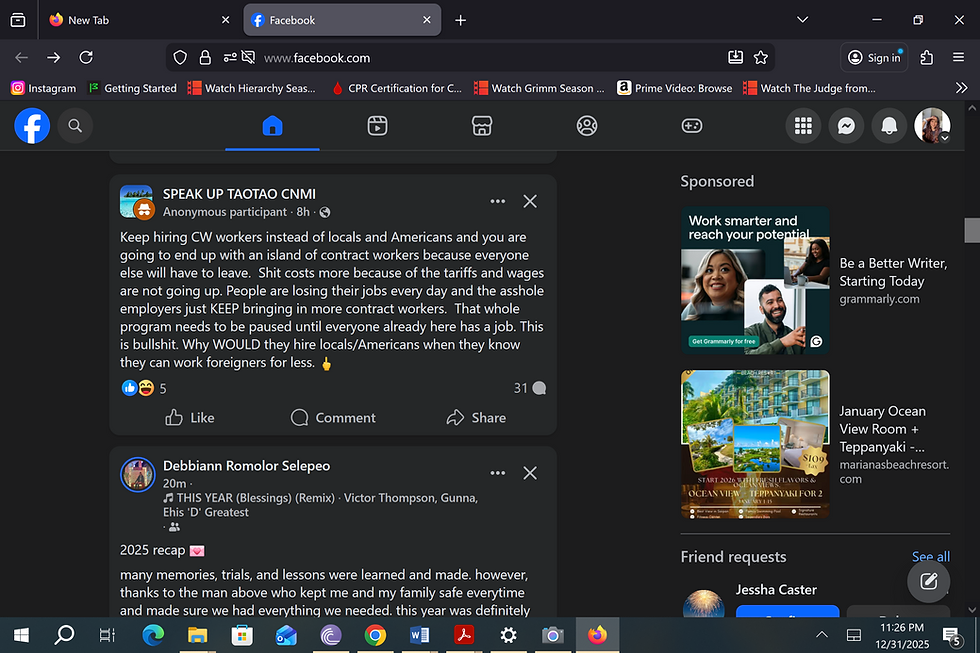
READ: WHAT THE LOCAL-SAIPAN,CNMI BASED INDIGENOUS ISLANDERS HAVE TO SAY ABOUT THE CNMI DEPT OF LABOR, WORKFORCE ENFORCEMENT , AND HOW FOREIGN BUSINESSES OVERTLY DISCRIMINATE / REFUSE TO HIRE AMERICAN CITIZENS; SO, THAT THEY CAN REMAIN IN AMERICA~! *** 20 CFR 655-VISA FRAUD***




Comments